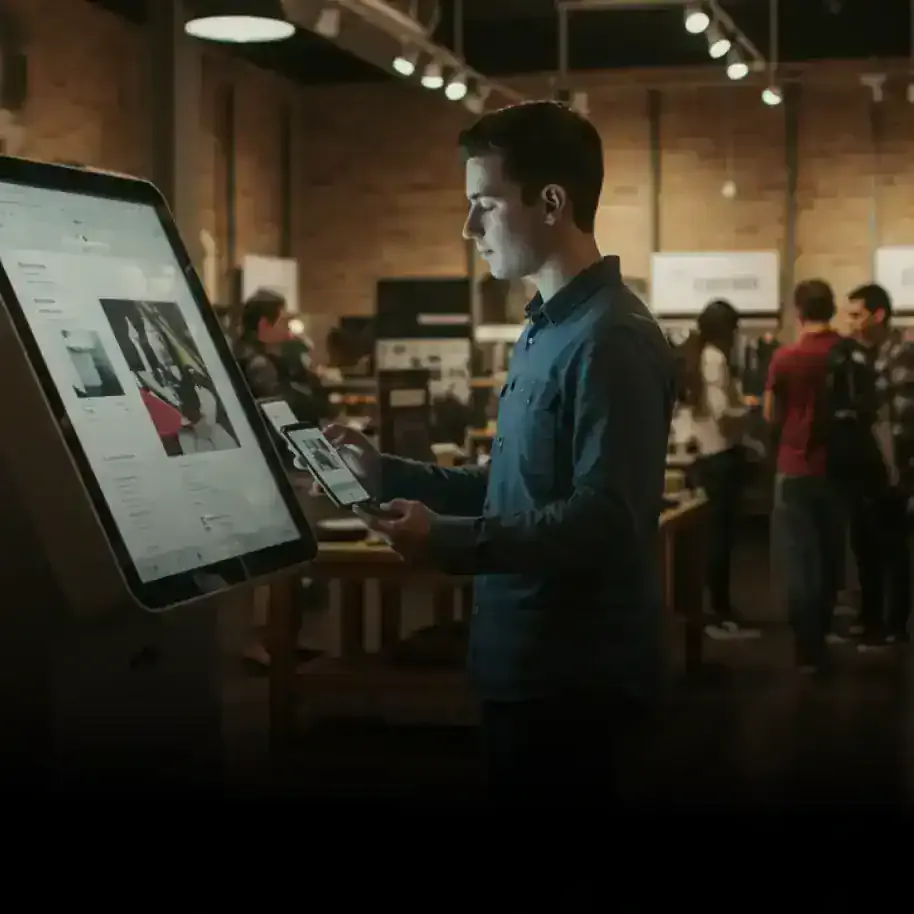
The retail landscape is undergoing an unprecedented transformation, where the fusion of the physical and digital worlds is no longer a futuristic vision but a tangible reality that’s redefining customer experience (CX) and retail business strategies. For those responsible for steering companies’ strategic direction and leading digital transformation in retail, understanding and capitalizing on these retail trends for 2025 is crucial for lasting success. This piece explores the most influential currents shaping the hybrid future of retail, from the rise of social selling to the pressing need for personalization in retail and continuous experimentation, offering an essential perspective for anyone looking to optimize the customer experience and drive innovation in the retail sector.
Digital transformation in retail: the new operating standard
Digital transformation in retail is no longer optional; it has become the central axis of any competitive strategy. As Aldo Gamarro, an e-commerce and digital channels specialist, points out, in recent years we’ve witnessed the awakening of this transformation, and concepts that once seemed remote are now central topics in high-level strategic debates. This evolution won’t stop any time soon; on the contrary, it will keep happening and demanding constant adaptation, a key challenge for those planning the future of their organizations.
The key trends in the digital transformation of retail include:
- Optimizing the omnichannel experience: Customers move seamlessly between physical stores, websites, mobile apps and social media. Modern consumers use an average of six touchpoints before making a purchase decision, and those who buy through multiple channels tend to spend significantly more.
- Data-driven decision-making: The use of artificial intelligence (AI) in retail and predictive analytics is fundamental to understanding customer behavior, optimizing inventory and personalizing offers.
- Emerging technologies: The Internet of Things (IoT), augmented reality (AR) for virtual product try-ons and blockchain for greater supply chain transparency are revolutionizing interaction and operational efficiency.
- Artificial intelligence (AI): AI is enabling automation and personalization in retail at an unprecedented scale, offering powerful tools to reach new levels of efficiency and connection with the customer.
The unstoppable rise of social selling in retail: lessons from Asia
Asia, and China in particular, has become an unavoidable reference for the future dynamics of the retail business. One standout phenomenon is the overwhelming success of social selling in retail. Platforms such as WeChat in China handle hundreds of millions of dollars in social media e-commerce transactions. This model, in which content creators sell products directly through live streams and interactive posts, is gaining enormous traction. In Southeast Asia, for example, 85% of social media shoppers find it quick and easy to buy products this way. “Live selling” has grown exponentially, especially since the pandemic, and is consolidating as a retail trend in Asia and globally.
This model is redefining retail marketing and sales strategies. Brands are adapting to capitalize on the unique opportunities social commerce offers, including collaborations with influencers, user-generated content and native shopping features built into social platforms. Spending per shopper on these platforms is expected to double between 2023 and 2027, signaling a long-term shift in buying patterns, a crucial data point for those defining market and expansion strategies.
A horizon of opportunities in Latin America
While social selling flourishes in Asia, in Latin America, and specifically in Mexico, e-commerce through WhatsApp stands out as a channel with enormous potential yet to be exploited at scale. Although there are excellent bots and generative AI is used for fluid conversations, there’s still no definitive benchmark that has marked a before and after for the footwear and fashion industry on this platform. That represents a significant opportunity for companies looking to differentiate themselves and capture new market segments in the region, exploring retail opportunities in Latin America.
Conversational commerce via WhatsApp offers:
- Unmatched reach: Billions of active users.
- Real-time sales assistance: Through live agents or chatbots, creating a guided, personalized shopping experience.
- Versatile use cases: From promotional messages and transactional alerts to after-sales support.
- High conversion potential: Strategies such as abandoned cart reminders and stock alerts are highly effective.
The key is to design experiences that let customers discover products, add them to the cart and complete the purchase, all within the same conversation, an approach that can drastically improve conversion rates and customer loyalty in retail.
Disruptive innovations in retail: technologies transforming the experience
The NRF show in New York is a showcase of the retail innovations that are setting the pace. One of the surprises is how retail technology solutions are becoming democratized. Implementing a gamification module, for example, which used to involve significant costs, is now more accessible thanks to agile, efficient startups. This opens new avenues for experimentation and continuous improvement.
Some standout technology innovations in retail include:
- 3D foot scanning for footwear: Devices that create a 3D model of the foot, connect it to inventory and filter out sizes that won’t fit, transforming the shopping experience.
- Avatar salespeople powered by generative AI: Virtual assistants that offer sophisticated sales interactions and continuous learning, and can be replicated in e-commerce.
- Virtual fitting rooms and smart mannequins: Technologies that enrich the in-store experience, letting shoppers view products interactively.
- Smart shelves: They optimize inventory management and the shopping experience through sensors and dynamic pricing.
- Cashierless checkouts and embedded payments: Solutions like Amazon Go that speed up the purchase process through the customer’s phone.
These innovations aren’t meant to replace the physical store, but to enhance it, creating a more efficient and attractive phygital retail ecosystem.
The phygital concept in retail: the strategic fusion of physical and digital
The term phygital in retail describes the ever-deeper integration between the physical store and digital tools, aiming to offer a richer, more efficient and more enjoyable phygital experience for the customer. It’s not about one channel cannibalizing the other, but a symbiosis in which each strengthens the other. The expectation is that companies maintain an ongoing relationship with the customer that goes beyond the simple transaction, through physical-digital integration.
Examples of phygital implementations in retail:
- ROPO (research online, purchase offline) and vice versa.
- QR codes for access to detailed product information.
- Virtual fitting rooms and smart mirrors.
- Click and collect (buy online, pick up in store).
- Showroom tablets to check online availability and place orders.
Personalization and customer experience (CX): the heart of modern retail
Personalization in retail is perhaps the most important battleground today. Customers don’t just expect tailored experiences; they demand them. 76% of consumers expect companies to understand and anticipate their needs. That means a deep understanding of their preferences in order to offer truly relevant recommendations and communications, an imperative for those who manage customer and marketing strategy in retail. CX in retail has become a key differentiator.
Technology, especially AI and machine learning, makes it possible to analyze large volumes of data to deliver real-time hyper-personalization. However, this personalization must be handled carefully so it isn’t intrusive, based on the customer’s explicit preferences. Aligning technology with what the customer values is fundamental. One example of an opportunity is proactive personalization in children’s clothing sales, anticipating future size needs.
Omnichannel and personalization in retail: an indispensable duo
Omnichannel in retail is the strategy that lets all of a company’s channels work together in an integrated way. Combined with personalization, its power multiplies. The goal is for customers to feel that the brand recognizes and values them, whatever the touchpoint. To achieve effective omnichannel personalization, it’s essential to build a unified customer database, map the customer journey, create dynamic segments and set clear goals. A well-executed omnichannel retail strategy doesn’t just improve satisfaction; it drives loyalty and CLTV.
The critical importance of experimentation in retail
In such a dynamic environment, a culture of experimentation in retail is vital. It’s not only about transforming technology, but also the mindset at every level of decision-making, to encourage a greater volume of tests. Experimenting is a rigorous business practice that involves defining hypotheses, measuring results and ensuring statistical representativeness, a powerful tool for mitigating risk and validating new initiatives. Innovation in retail feeds on experimentation.
Today, modular solutions and AI have reduced costs, making it possible to run multiple experiments with less investment. The goal is to run dozens of tests a month, learning from successes and failures.
Strategic tips for innovating in the retail of the future
Innovating in today’s retail requires a proactive mindset. Aldo Gamarro offers three key tips for anyone looking to drive innovation and transform the customer experience:
- Foster a living culture of experimentation: Test constantly; the learning is invaluable. Doing nothing isn’t an option.
- Dive into AI tools, many of them free or affordable: Explore the tools available to strengthen every professional role. Those who work best with AI will lead.
- Stay curious and learn globally: Research trends in other industries and regions. Identifying best practices can generate ideas that apply locally. This global view is crucial to anticipating change and discovering new growth opportunities in retail.
Embracing the hybrid future of retail with agility and intelligence
The future of retail is undeniably hybrid, an amalgam of physical experiences enriched by digital intelligence. For those leading strategy and execution in the dynamic retail sector, the challenge and the opportunity lie in embracing this transformation with a mindset of constant curiosity and fast learning. The ability to experiment, personalize at scale, integrate channels seamlessly and adopt technology innovations in retail aren’t just trends but strategic imperatives. The organizations that navigate this new paradigm with agility and a customer-centered approach will be the ones that thrive in the exciting new era of retail, ensuring relevance and sustained growth in an evolving market.
Credits

As Director of Strategy and Innovation at Soho, he leads and oversees initiatives that drive growth and market differentiation. With more than 10 years of experience in the field, Martin has developed a strategic vision and a practical approach to delivering innovative, user-centered solutions that meet the needs and expectations of diverse audiences and markets.